Do the work while drawing, after pen-up, or both?
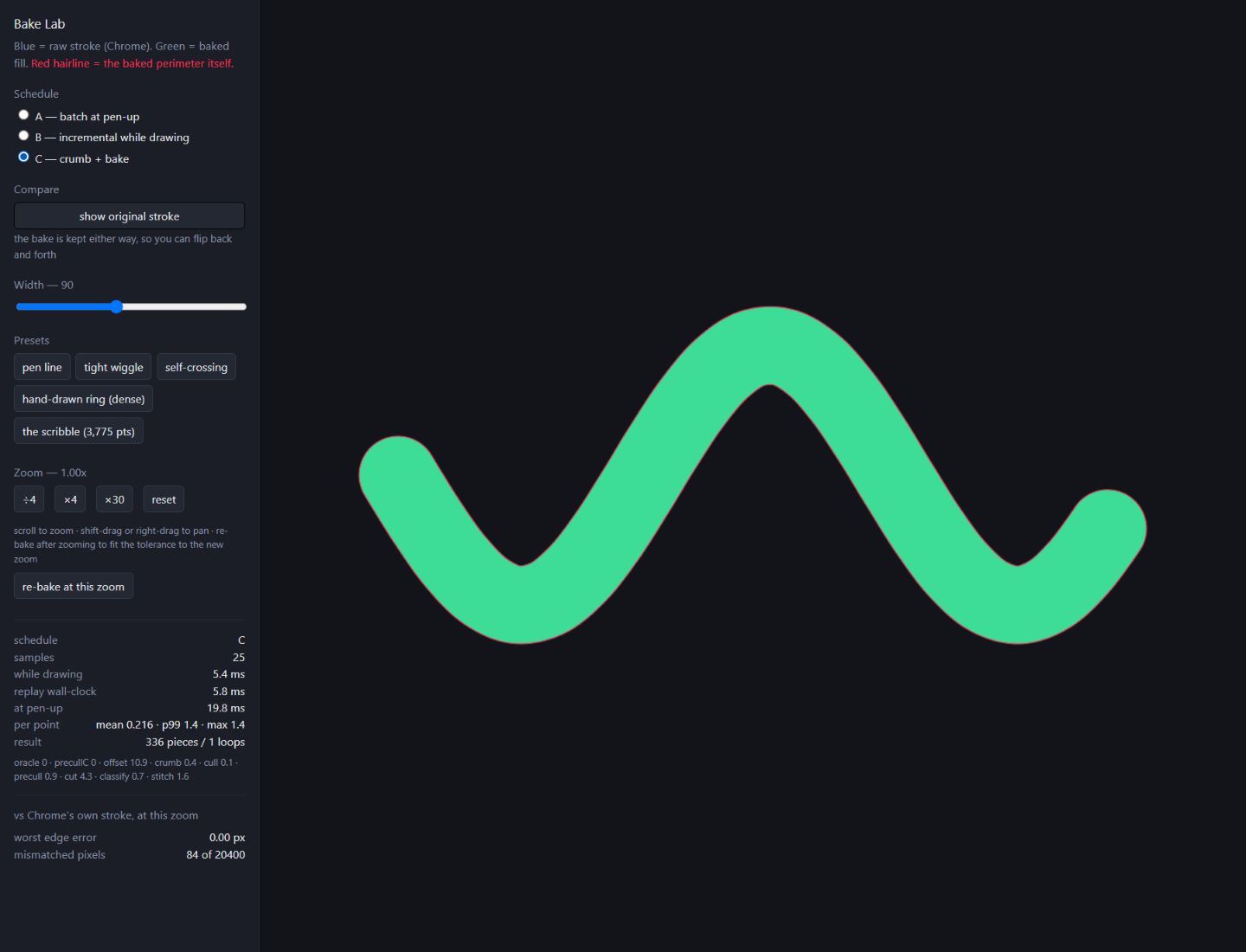
Bake Strategy Lab replays one stroke through three ways of scheduling its outline calculation. Compare steady drawing with the pause that can happen when the pen lifts.
The engineering question
A complicated pen stroke can require expensive work to turn overlapping ink into one clean boundary. Where that work happens changes how drawing feels: putting it all after pen-up can pause, but doing too much during drawing can make the pen stutter. This lab replays the same stroke through three schedules so the tradeoff can be measured.
What the lab makes visible
A hybrid schedule records cheaper coverage information while drawing, then finishes the boundary after pen-up. Replaying the same stroke makes the timing comparison useful: the input stays the same while the schedule changes.
- A — batch: resolve the outline after pen-up.
- B — incremental: maintain the result while drawing.
- C — crumb + bake: record cheap coverage hints, then finish after pen-up.
Try it
- Choose a small preset or draw a stroke.
- Switch A, B and C to replay that exact stroke through each schedule.
- Compare while-drawing time, pen-up time and the per-point tail.
- Toggle the original stroke and inspect the red outline to check whether the result changed.
What it showed
Crumb + bake (C) won at first, when strokes were made of thousands of small pieces and the hints let the bake skip most of them. Once strokes became smooth curves made of far fewer pieces, the hints had little left to skip. bound.less now resolves each stroke’s outline once, at pen-up, like schedule A.
An earlier experiment from bound.less
I used AI to build focused tools for comparing engineering choices in bound.less. These pages make an abstract choice visible and measurable, so I could inspect the result and decide what to build next.
This version comes from the project’s revision of August 26, 2026. The lab pages were later removed from the main app, which has kept evolving; the geometry code here is from that same revision.
How to read the results
This lab preserves the earlier cubic pipeline and its experimental schedules, not the current bound.less version. Start with the small presets: the dense ones can make the page pause. The accuracy readout checks this experiment only, not every renderer.