What would it take to make a smartphone from nothing?
An educational research project that follows a familiar object back through the materials, tools and industries needed to make it. The map makes that growing web of dependencies explorable.
The question that started it
A smartphone is an everyday object with an extraordinary amount of civilization hidden inside it. I wanted to understand that hidden world: not just what a phone contains, but what people would need to make its parts, and then make the tools that make those parts.
The thought experiment, in plain language: imagine a knowledgeable group starting on an Earth untouched by humans. They have people and knowledge, but no manufactured objects, prepared materials, factories or utilities. What would it take to produce a modern smartphone?
The purpose is educational: use one recognizable object to explore how technology and industry depend on one another.
Why it became a research system
Following one question quickly opens many others. A speaker needs wire; making wire requires suitable metal, tools and checks; those tools have their own prerequisites. Different branches may need the same equipment, and a proposed tool may accidentally depend on the very thing it is meant to make.
I built a shared research registry and interactive map so these relationships could accumulate without turning into disconnected chat answers. Each item has an identity, proposed making routes, dependencies, evidence and a visible research status.
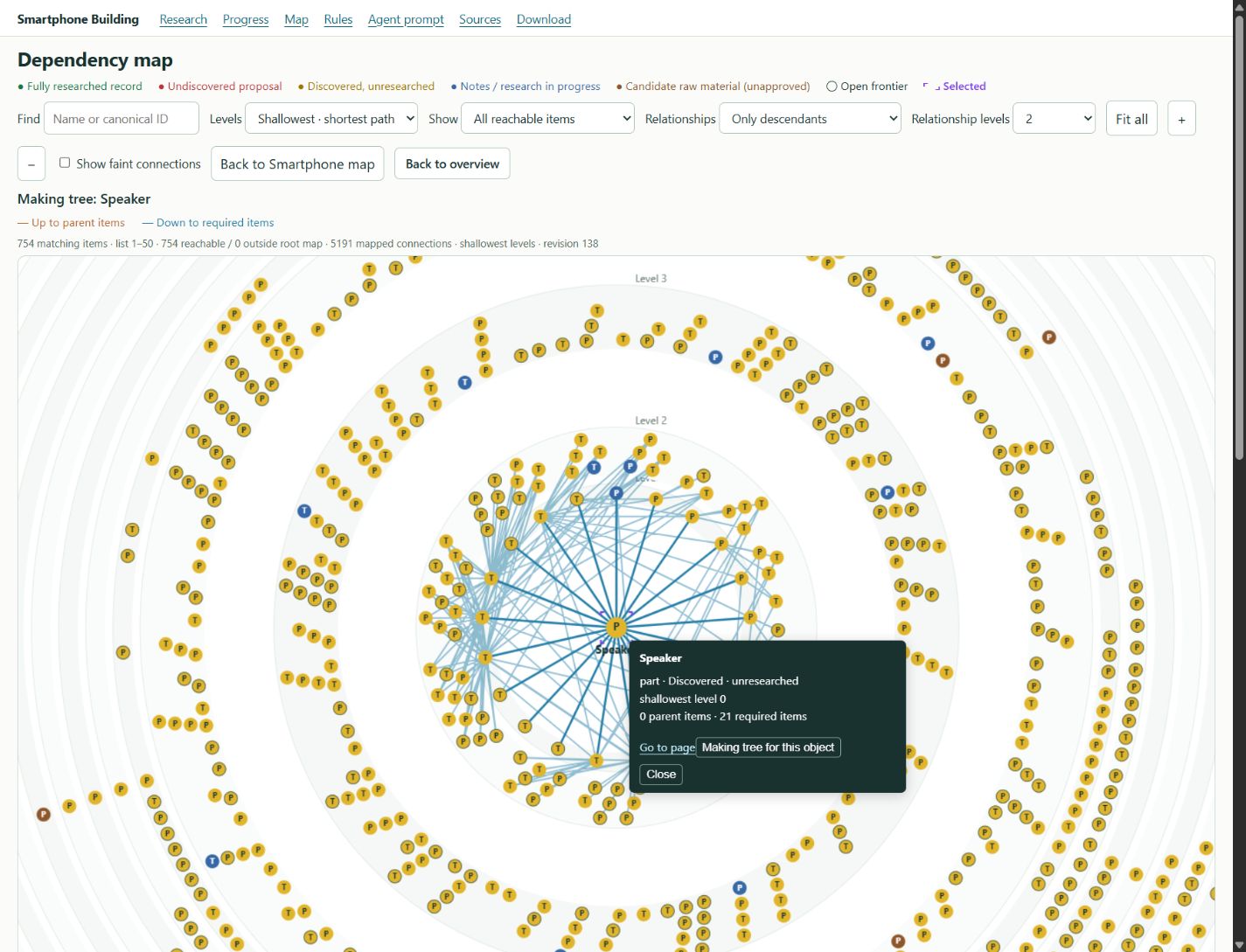
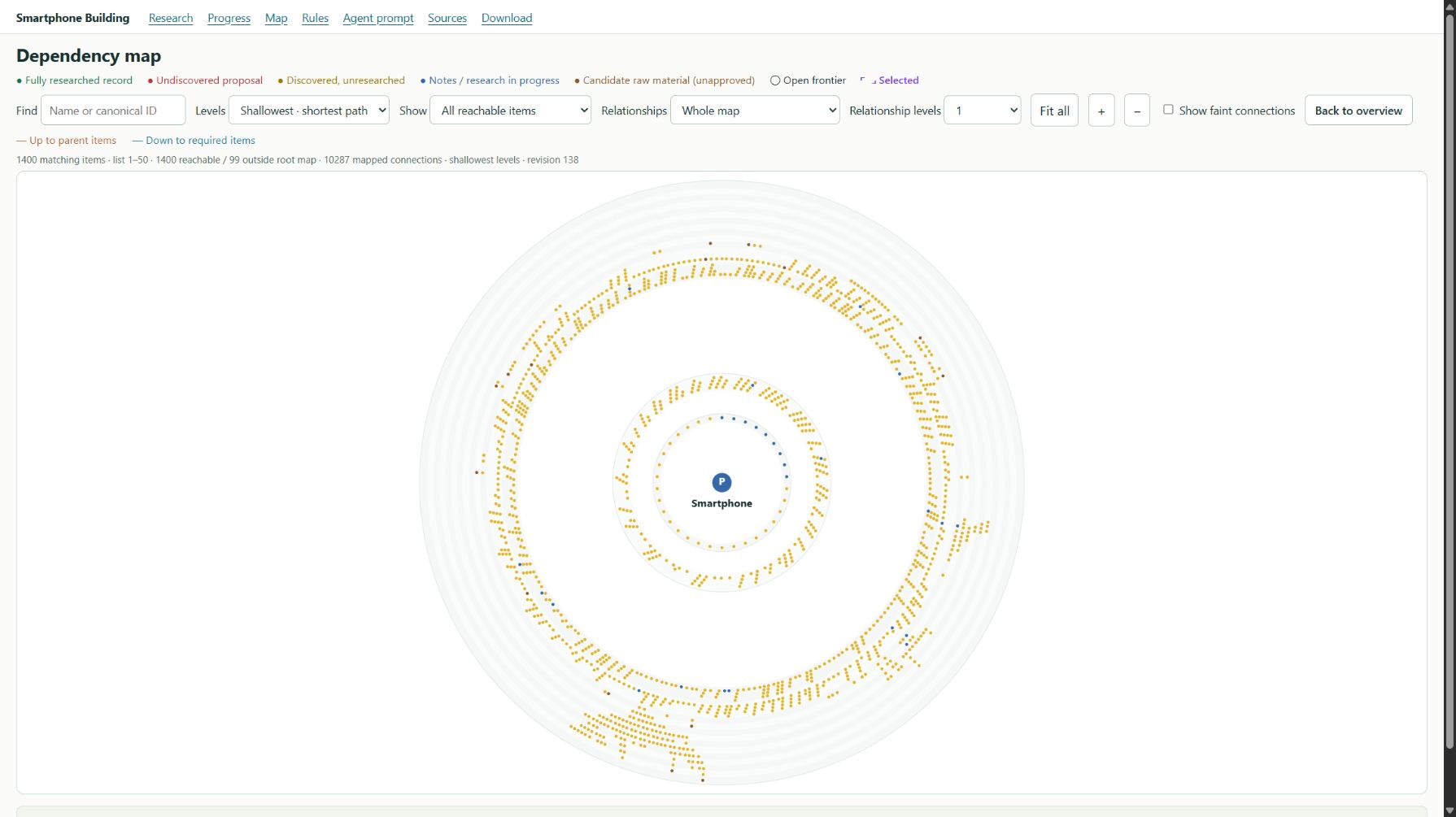
See the full-map overview
How the workflow works
- Discover the next layer. Agents identify immediate parts and tools, checking whether an existing item can be reused.
- Check the shared map. Code rejects broken references, conflicting revisions and circular selected dependencies before accepting a change.
- Research and review. Bounded assignments attach sources, assumptions, unresolved requirements and review states to particular items.
- Publish the same data in several views. The map, item pages and reading edition are generated from the validated registry.
- Inspect the gaps. Human review guides the next research question rather than treating a connected diagram as a finished answer.
Try following a simple part
Open the map and search for Copper wire. Inspect its making tree, follow a prerequisite, and look at what uses the result. Compare shallowest and deepest placement to see how one shared item can sit within many chains.
The companion Smartphone Prototype Lab asks a different question: how could this information become a visual learning experience that is enjoyable to explore? Those prototypes are authored separately; they do not yet load their content automatically from this map.
My contribution and the role of AI
I set the learning goal, the meaning of the relationships, the review criteria and the direction of the experience. AI agents supported discovery, focused research, critiques and implementation. The software protects the shared structure and publishes it consistently; it cannot establish the truth of a manufacturing claim.
An open investigation, with honest unknowns
The revision-138 snapshot contains 1,507 records, 825 candidate making routes and 734 selected routes. Most records are discovery hypotheses. It reports zero closed manufacturing paths: this is a map of an investigation, not a demonstrated recipe for making a phone.
The software passes 79 tests. That supports the graph and publishing behavior, not physical feasibility. The research scope targets a handset that could work in today’s world; external network infrastructure, outlets and an external charger are outside the build.